
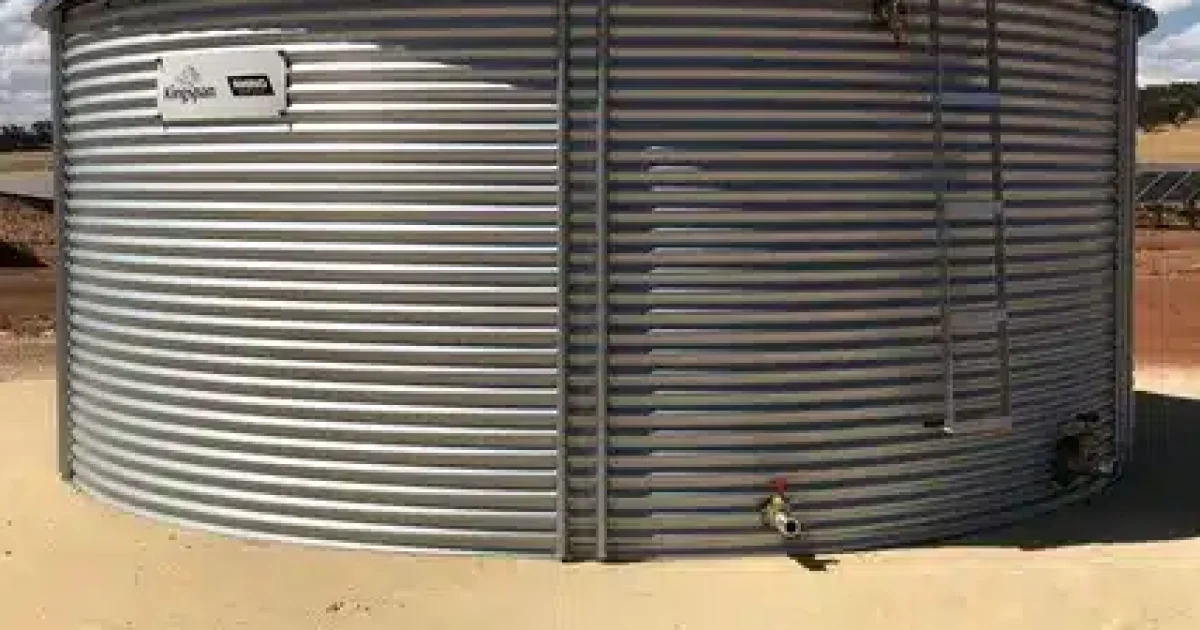
Choosing the best water tank size for a family is not simply about buying the biggest tank that fits in the backyard. The right capacity depends on how many people live in your home, how much water you use, the size of your roof, local rainfall, available space, and whether the tank is used for garden watering or the entire household.
For many New Zealand families, a 10,000 to 25,000 litre rainwater tank can be a practical starting point. However, households relying completely on rainwater may need considerably more storage.
In Auckland, for example, Auckland Council modelling shows that a 25,000-litre tank connected to a 150 m² roof could supply around 81% of full household water demand under its modelled conditions. For non-potable indoor and outdoor use, the same tank could supply about 99%.
So, what size water tank is best for your family? Let’s look at the numbers and the factors that actually matter.
As a general guide, the following best water tank size for a family can help you narrow down your options:
| Family size | Typical tank size to consider | Suitable for |
|---|---|---|
| 1–2 people | 3,000–10,000 litres | Garden, toilets, laundry or supplementary supply |
| 3–4 people | 10,000–20,000 litres | General household and outdoor use |
| 4–5 people | 15,000–25,000 litres | Larger homes and greater rainwater use |
| 5–6+ people | 20,000–35,000+ litres | High household demand or off-grid living |
| Rural/off-grid household | 30,000–50,000+ litres | Main household water supply |
These are starting points rather than fixed rules Best Water Tank Size.
A four-person family with a large roof and good rainfall may collect considerably more water than a six-person family living in a smaller home with limited roof catchment.
Auckland Council states that tank selection should consider the number of occupants, roof area, intended water use, mains-water connection and available space.
A 10,000 litre water tank can be a good option for a small family or for homeowners who want to supplement their mains supply.
It can work particularly well when rainwater is being used for:
However, 10,000 litres may not provide enough storage for a larger family that wants to rely on rainwater for most household needs.
The key issue is not only the tank capacity. It is how quickly the tank is used and how quickly rainfall replaces the Best Water Tank Size.
If four people use hundreds of litres every day, a 10,000-litre tank can be depleted surprisingly quickly during a dry period.
For many New Zealand households, 20,000 litres is a strong middle-ground option.
A 20,000-litre best water tank size provides substantially more reserve capacity than a small garden tank while remaining more practical than a very large rural storage system.
It can be particularly suitable for a family of four using rainwater for a mixture of indoor and outdoor purposes.
Before choosing 20,000 litres, however, check your roof catchment area and local rainfall.
Auckland receives approximately 1,200–1,250 mm of rainfall annually, while rainfall patterns vary considerably throughout New Zealand.
That means the same tank size can perform very differently in Auckland, Wellington, Christchurch, Hamilton or a rural property.
A 25,000 litre water tank is often worth considering when a family wants greater water security.
It provides a useful buffer during periods when rainfall is lower than normal and can be particularly attractive for homes that use rainwater for more than just the garden.
Auckland Council’s household rainwater guidance includes 25,000 litres as one of its larger residential storage examples. Its modelling indicates that, based on a 150 m² roof, a 25,000-litre tank could supply approximately 99% of modelled non-potable indoor and outdoor demand and about 81% of full water demand.
That does not mean every Auckland property will achieve the same result. Roof size, household consumption and rainfall patterns all affect performance.
For a family of four, a sensible starting range is usually 10,000 to 25,000 litres, depending on how the water will be used.
If the tank is mainly for garden watering and outdoor jobs, a smaller tank may be sufficient.
A 3,000 to 10,000 litre tank can provide useful storage without taking up excessive space.
If rainwater will supply toilets, washing machines and other non-potable household uses, consider moving towards 15,000 to 25,000 litres.
The larger capacity gives you more storage between rainfall events.
If rainwater is the primary or only water supply, tank sizing becomes much more important.
A 25,000 to 35,000 litre tank or larger system may be more appropriate, depending on roof area, rainfall and expected water consumption.
For completely off-grid properties, Auckland Council recommends a minimum of 50,000 litres as a general starting point for properties not connected to the mains network, while also warning that prolonged dry periods may require supplementary water deliveries.
A five-person household generally needs more storage than a couple or small family.
A 20,000 to 30,000 litre tank can be a reasonable range to investigate, particularly if rainwater is used for household purposes.
If the family also has a large garden, frequent outdoor water use or a property without mains water, going larger may make sense.
The important thing is to calculate demand rather than choosing a tank purely according to the number of people.
Water consumption is one of the most important factors in rainwater tank sizing.
Watercare says people in Auckland typically use around 140 to 170 litres per person per day.
That means a household of four could potentially use around:
4 people × 140–170 litres = 560–680 litres per day
Over 30 days, that represents approximately 16,800 to 20,400 litres.
This illustrates why a 10,000-litre tank may not provide a long reserve for a family of four using rainwater throughout the home.
Actual consumption varies significantly depending on showers, baths, laundry, toilets, garden irrigation, appliances and household habits.
Your roof is effectively the collection surface for your rainwater harvesting system.
A larger roof can collect more rain, allowing a tank to refill more quickly.
For example, a house with a 200 m² roof generally has more rainwater collection potential than a house with a 100 m² roof in the same location.
This is why tank capacity should always be considered together with roof catchment area.
Buying a huge tank does not automatically mean you will have more usable water. If the roof does not collect enough rainfall to refill it, much of that capacity may remain unused.
A basic estimate is Best Water Tank Size:
Roof area × rainfall × collection efficiency = potential water collected
For example, a 150 m² roof receiving 10 mm of rain could theoretically collect roughly 1,500 litres before allowing for losses and system efficiency.
That makes rainfall patterns just as important as tank size.
Yes. Rainwater tank sizing in New Zealand should be location-specific whenever possible.
A tank that performs well in one city may not provide the same level of water security somewhere else.
Auckland has relatively high annual rainfall, but dry periods can still place pressure on household water supplies.
For Auckland homes, tank sizing should consider roof area, household demand and whether water is being used for outdoor purposes, non-potable indoor use or the full household supply. Auckland Council provides a rainwater tank calculator and household guidance for this purpose.
Wellington properties can experience different rainfall patterns from Auckland, with local conditions varying significantly between suburbs and surrounding areas.
For a Wellington household, do not simply copy an Auckland tank recommendation. Use local rainfall data and your expected household demand.
Christchurch has different rainfall characteristics again, so storage requirements should be assessed around local rainfall, roof size and seasonal demand.
Large gardens can also increase summer water consumption, making additional storage useful.
For Hamilton homes, consider both household demand and garden requirements. A larger tank can provide a useful buffer where rainwater is used during drier periods.
Off-grid homes need a different approach from properties connected to mains water.
When the tank is your primary water source, you need enough storage to cope with periods when rainfall is insufficient.
This means the calculation should consider:
Estimate realistic daily use for every person living at the property.
Do not size the tank only around average rainfall. Extended dry periods are often when storage matters most.
A large tank is only useful if your roof can collect enough water to fill it.
Some rural properties may need tanker deliveries during prolonged dry weather. Best Water Tank Size
Auckland Council specifically recommends at least 50,000 litres for households not connected to the mains supply and notes that supplementary water may still be necessary during prolonged dry periods.
You do not necessarily need a 20,000 or 30,000 litre tank simply to water the garden.
For smaller outdoor applications, 1,000 to 5,000 litres can be useful, depending on garden size and rainfall.
Auckland Council lists rain barrels from around 100–1,000 litres and slimline tanks from approximately 800–5,000 litres, while standard residential tanks can range from about 1,000 to 20,000 litres.
For a large garden, multiple tanks can sometimes be more practical than one enormous tank.
There is no universal answer Best Water Tank Size.
One large tank can offer greater storage capacity with fewer connections and potentially simpler management.
Multiple tanks can provide flexibility, especially where property shape or access makes a large tank difficult to install.
For example, a homeowner might install two 10,000-litre tanks rather than one 20,000-litre tank.
This can make better use of available space and may simplify future expansion.
A large tank can provide:
Multiple tanks can provide:
The best arrangement depends on your property layout and plumbing design.
Tank capacity is only one part of the decision.
Measure the proposed installation area before choosing a tank.
Auckland Council notes that tank type and size need to be considered alongside available space, and different tank designs are available for restricted areas.
Slimline tanks can be particularly useful where width is limited.
Check whether the tank can physically reach the installation area.
A tank may fit on paper but be difficult to transport through a gate, around a house or into a backyard.
Make sure your roof can provide enough rainfall to justify the tank capacity.
If water needs to reach toilets, washing machines or irrigation systems, you may need an appropriate pump and plumbing setup.
If rainwater will be used for drinking, additional treatment and appropriate system design may be required.
Do not assume that water collected from a roof is automatically suitable for drinking Best Water Tank Size.
Installation requirements can vary by location and by how the tank is connected.
For example, Auckland Council notes that a building consent may still be required for rainwater tanks connected to internal household plumbing, even though many residential tank installations no longer require resource consent.
Always check the current requirements for your property before installation.
A larger tank provides more storage, but it does not create water.
If rainfall is limited for an extended period, even a large tank can eventually run low.
This is why the best rainwater tank for a family is a balance between storage capacity and expected water collection.
For example, increasing a tank from 10,000 to 25,000 litres can significantly increase your reserve, but the benefit depends on whether your roof and local rainfall can refill that additional capacity.
If you want a simple starting point, use this guide Best Water Tank Size:
2 people: Consider 5,000–10,000 litres.
3–4 people: Consider 10,000–20,000 litres.
4–5 people: Consider 15,000–25,000 litres.
5–6 people: Consider 20,000–35,000 litres.
Off-grid household: Investigate 30,000–50,000+ litres and calculate storage against local rainfall and dry-period demand.
These ranges are not a substitute for proper site-specific sizing, but they can help you narrow down your options Best Water Tank Size.
The best water tank size for a family in New Zealand is the one that matches your actual water demand, roof catchment, local rainfall and intended use.
For a typical family, 20,000 to 25,000 litres can be a sensible size to investigate when rainwater is intended for significant household use. A smaller 5,000–10,000 litre tank may be enough for garden watering or supplementary supply, while rural and off-grid households may need 30,000–50,000 litres or more.
Rather than choosing a tank based only on family size, look at the whole system.
Count the people. Measure the roof. Estimate daily water use. Check local rainfall. Consider dry periods. Then choose the tank capacity Best Water Tank Size.
That approach can help you avoid paying for storage you will rarely use while also reducing the risk of running out of water when you need it most.
For Auckland homeowners, Auckland Council’s rainwater tank guidance and calculator are useful starting points for checking how different tank capacities may perform on your property.
A 5,000-litre tank can be useful for a small household, garden watering or supplementary water use. It is unlikely to provide a large reserve for a family relying on rainwater for the entire home.
It can be suitable for outdoor or selected indoor uses, but it may be limiting if four people depend on rainwater for most household needs.
It can be a good option for many four-person households, particularly when combined with a suitable roof catchment and local rainfall. Your actual water demand should determine the final size.
For many families, 25,000 litres offers substantial storage. However, an off-grid household may require considerably more, particularly where long dry periods are possible.